Why the Forest Feels Cooler Than the City
(5 min read)
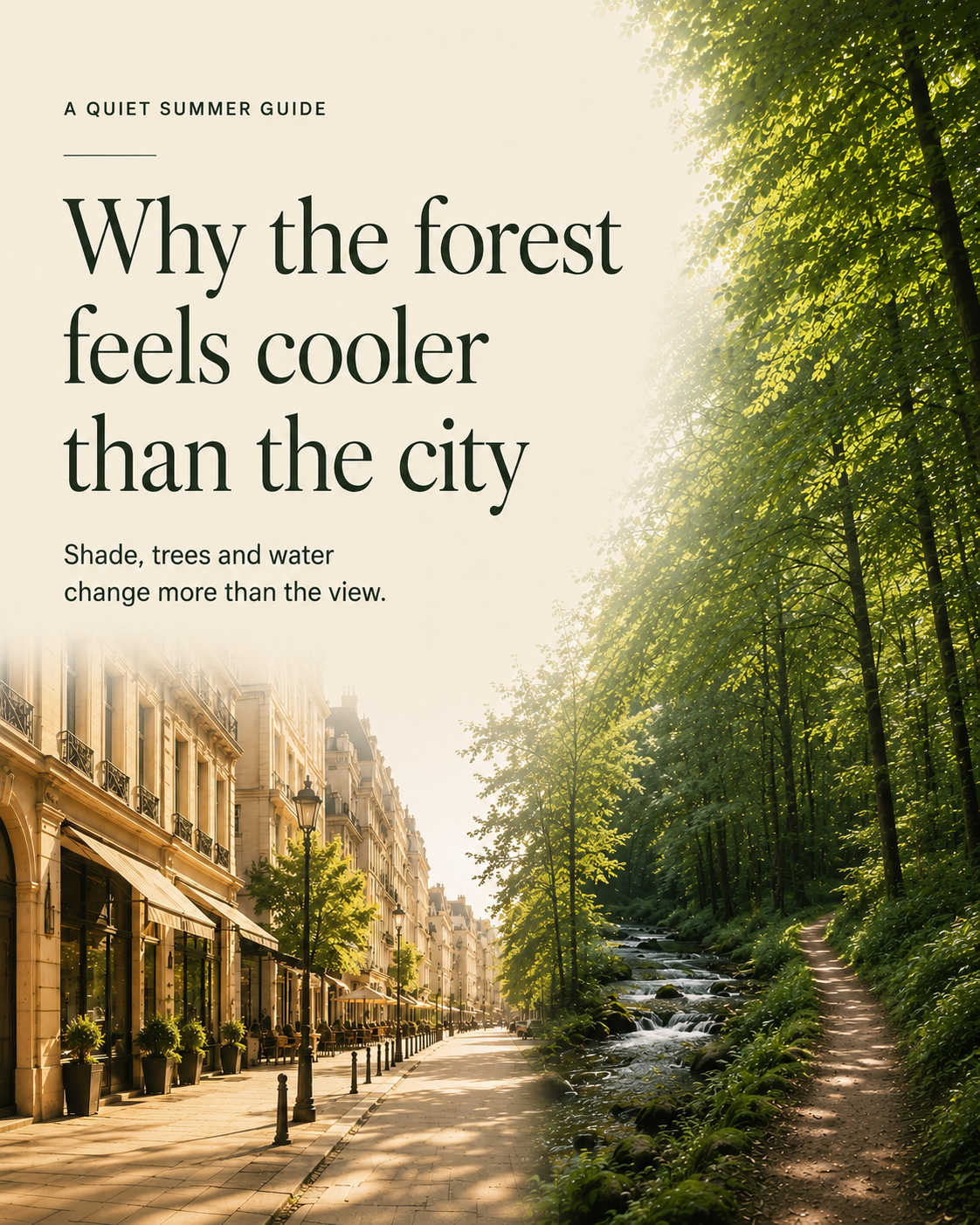
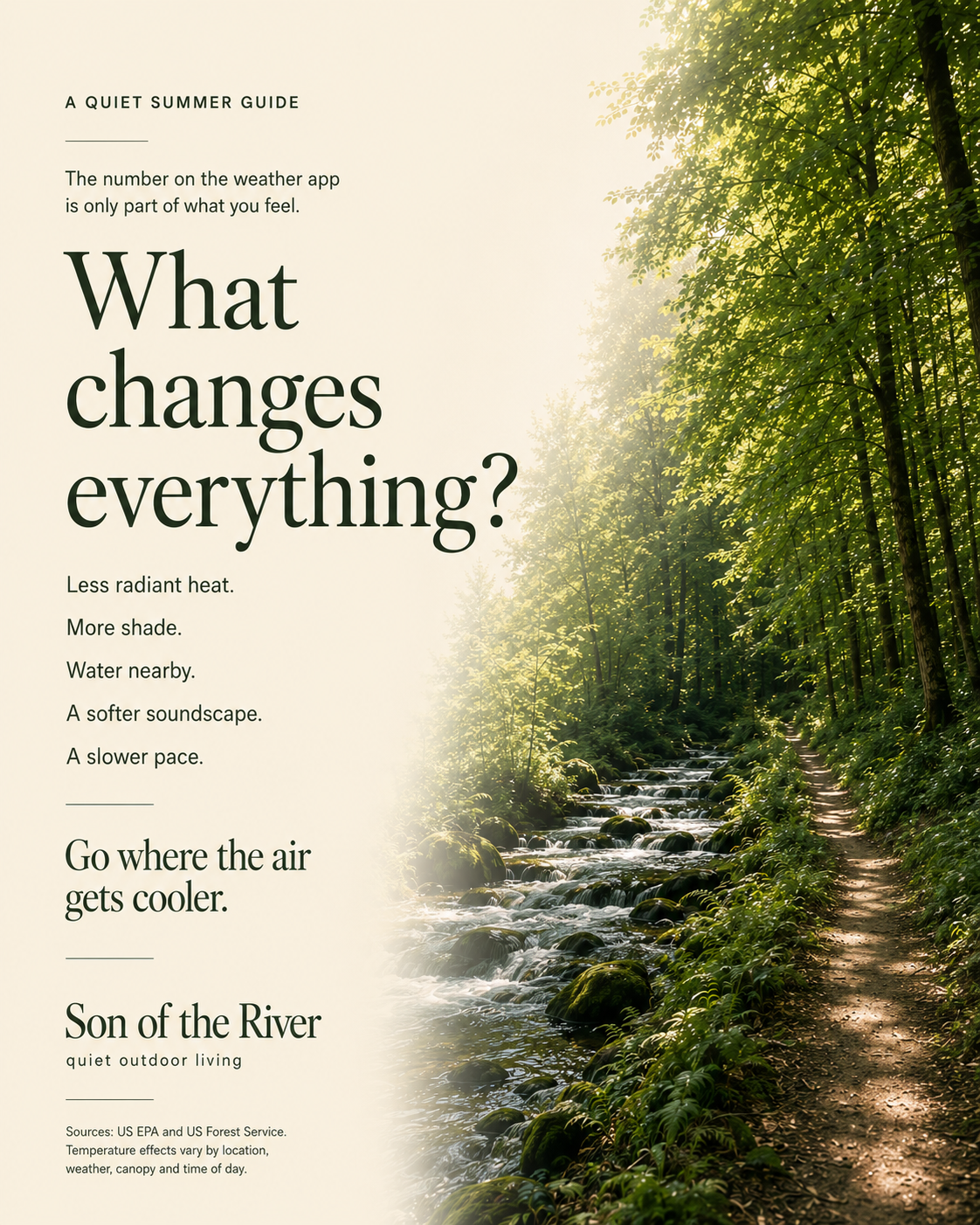
Step from a sunlit street beneath a canopy of trees and the change can feel immediate.
Less glare.
Cooler ground.
Softer light.
It is not only the view that has changed.
On a warm summer day, walking from an open street into a forest can feel like entering another climate.
In a way, you are.
The difference is created by a combination of shade, living trees, cooler surfaces and moisture.
But there is something else happening too.
The forest changes how we experience the heat.
It starts with shade
The most obvious difference is above us.
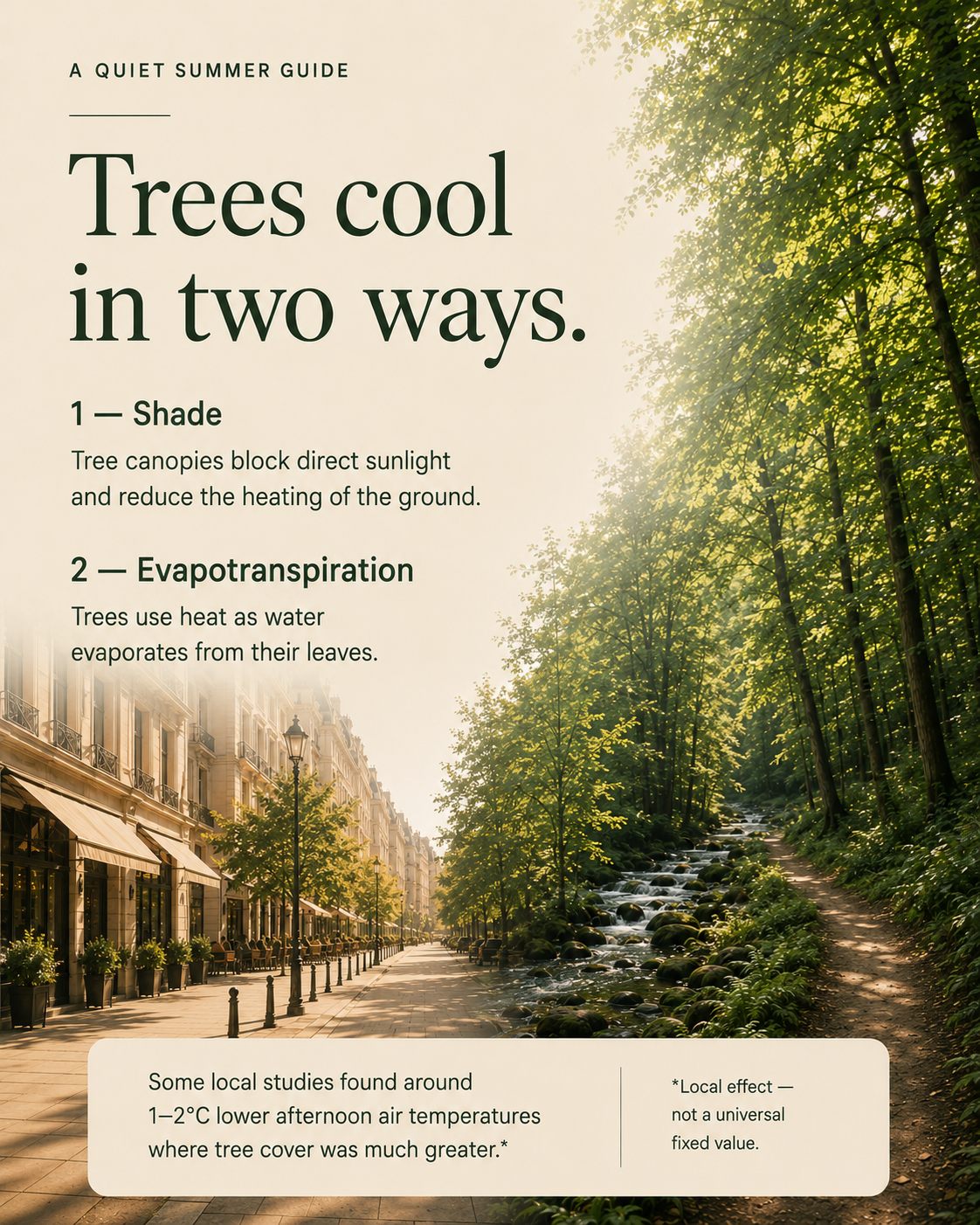
A tree canopy intercepts much of the direct sunlight that would otherwise reach the ground, our skin and the surfaces around us.
That matters because exposed stone, asphalt and buildings can absorb large amounts of solar energy and become far hotter than the surrounding air.
Beneath trees, much of that direct radiation never reaches the ground in the first place.
The result is not simply darker surroundings.
It is less heat being absorbed by the surfaces around us.
And we can feel the difference quickly.
Think about stepping barefoot from a sunlit stone terrace onto a shaded patch of ground.
The air may not have changed dramatically in those few steps.
But your experience has.
Trees do more than create shade
A forest canopy is not an umbrella made of wood.
It is alive.
Trees draw water from the soil and release part of it through their leaves.
This process is called evapotranspiration.
Turning liquid water into water vapour requires energy. Some of that energy comes from heat in the surrounding environment, creating a natural cooling effect.
Together with shade, this is one of the main reasons vegetation can lower local surface and air temperatures.
The effect is not identical everywhere.
It changes with weather, humidity, soil moisture, tree species, canopy density and how much water is available to the trees.
Nature rarely gives us one simple number.
But the principle is remarkably simple.
Trees do not only block heat.
Living trees also help move it.
The ground matters too
Look down in a forest.
The ground is rarely a continuous sheet of exposed stone.
There may be soil.
Leaves.
Roots.
Moss.
Plants.
Small pockets of moisture.
And almost all of it sits beneath some degree of shade.
Compare that with a city street in full summer sun.
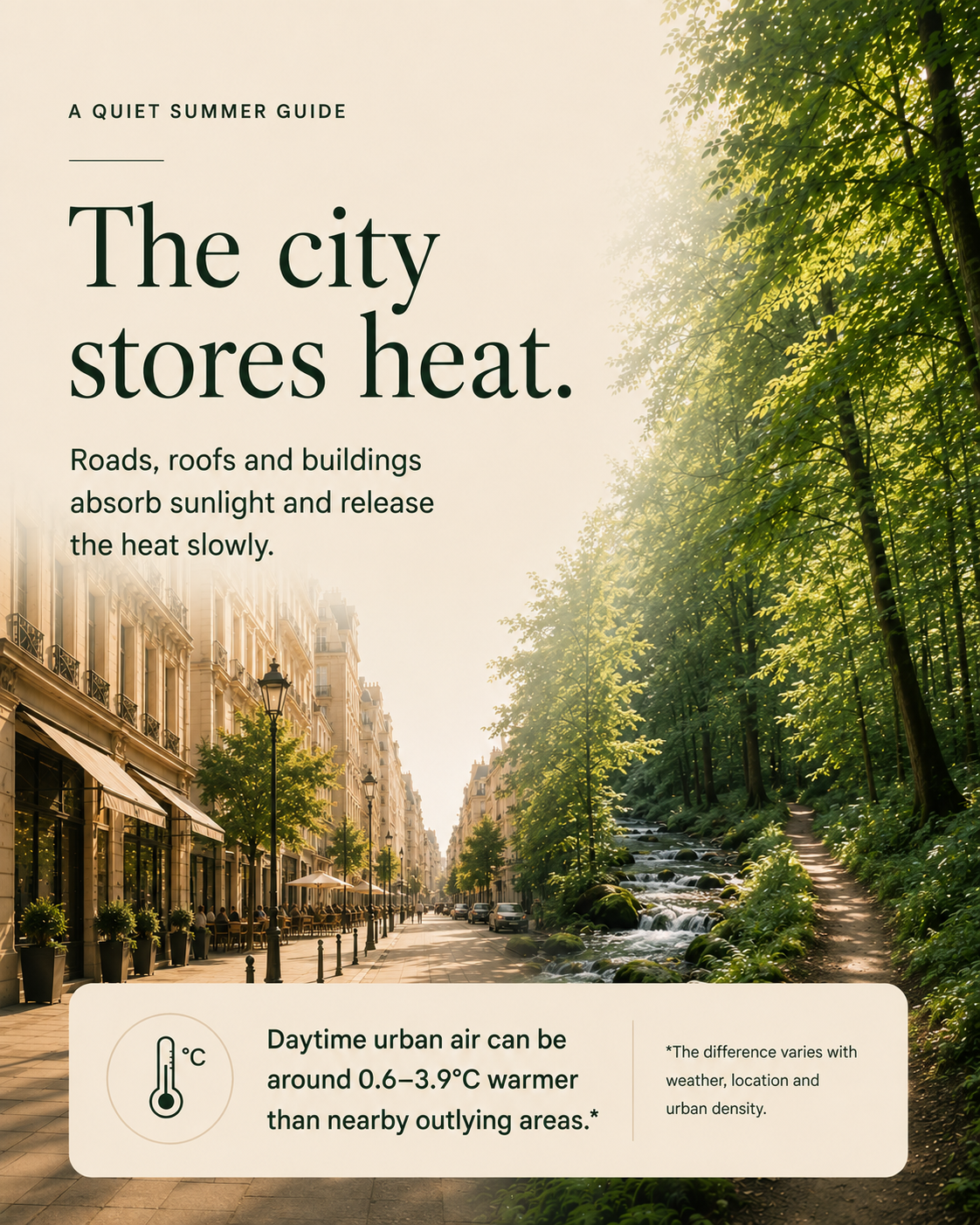
Roads, walls, paving stones and roofs can absorb solar energy during the day and release part of that stored heat later.
This accumulation of heat across built surfaces contributes to what is known as the urban heat island effect.
A forest works differently.
Less incoming radiation reaches the shaded ground, vegetation is actively exchanging water with the atmosphere, and far less of the landscape consists of exposed heat-storing materials.
The difference is something we notice before we ever think about the science.
We simply call it cooler.
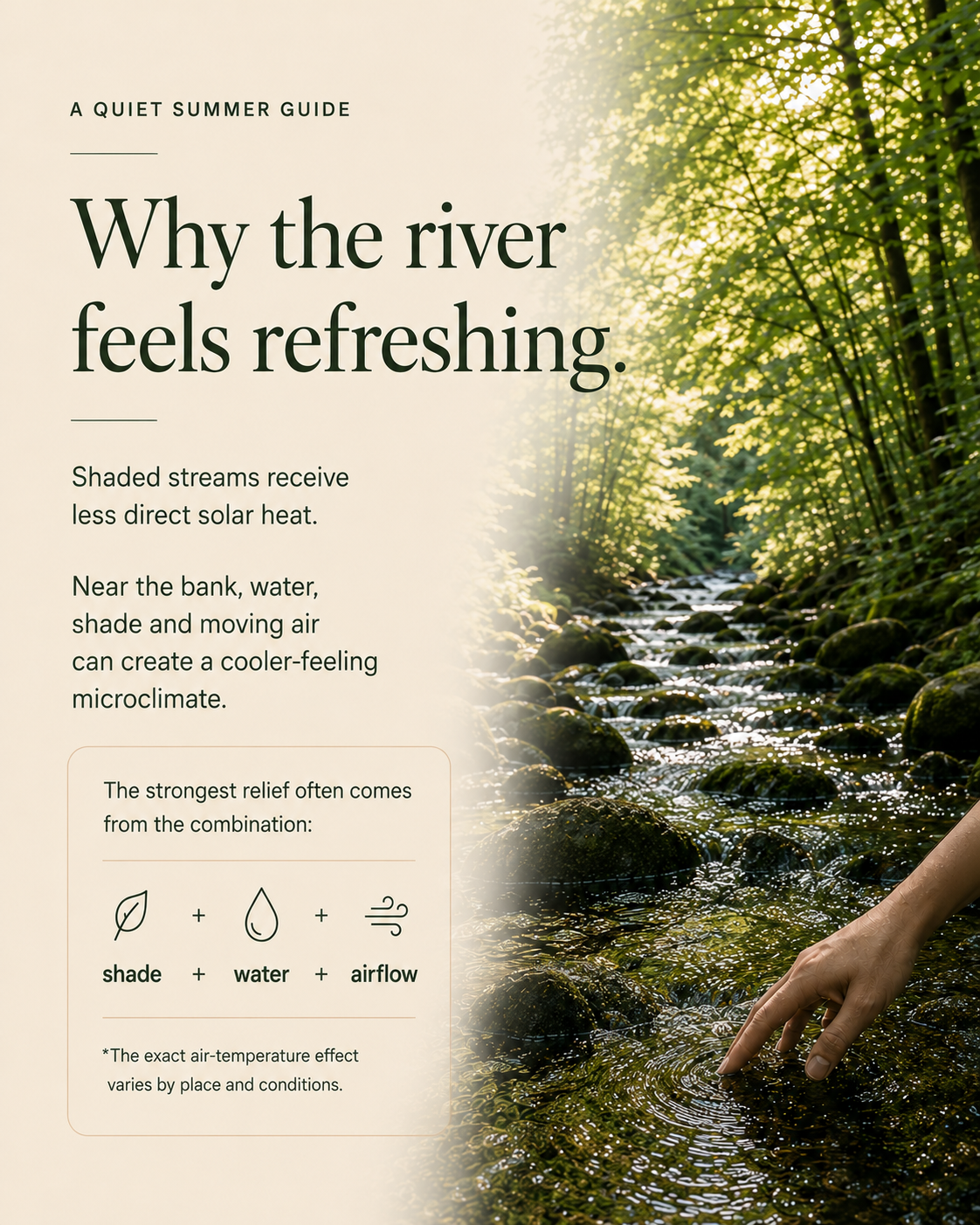
And then there is water
For Son of the River, water is naturally part of this story.
A small stream running through a shaded forest does not need to transform the temperature of an entire landscape to change how that place feels.
The sound is different.
The surfaces around it are often damp.
Light moves across the water.
You notice the air against your skin.
You slow down near it.
Water becomes part of a collection of small signals telling us that this environment is different from the hard, exposed surfaces we have left behind.
That may be why a shaded riverbank on a hot day can feel like more than simply another place outside.
It feels like relief.
Cooler is something we feel, not just something we measure
Temperature is only one part of thermal comfort.
Direct sunlight matters.
The temperature of the surfaces around us matters.
Humidity matters.
Air movement matters.
And so does the amount of heat our bodies gain from radiation.
This is why standing beneath a tree can feel dramatically more comfortable even when a nearby thermometer does not show an equally dramatic change in air temperature.
Research on urban trees consistently finds that shade can substantially improve human thermal comfort, particularly by reducing direct solar radiation and the heat coming from surrounding surfaces.
Our bodies experience a place as a whole.
Not as a number.
The city keeps some of the day
There is another difference that becomes especially noticeable after a hot afternoon.
Many built surfaces do not stop influencing us when the sun disappears behind a building.
Materials that have absorbed energy throughout the day can release some of that heat again.
This is one of the reasons densely built environments can remain uncomfortably warm after sunset and why urban heat islands are often especially apparent at night.
A shaded forest floor has lived through a different day.
Less direct sunlight.
More vegetation.
More moisture.
Less exposed concrete, stone and asphalt storing the afternoon sun.
By evening, the difference can feel almost instinctive.
One place seems to hold onto the day.
The other begins to let it go.
Maybe that is why we slow down there
The science explains part of the feeling.
But perhaps not all of it.
Walk beneath trees and the light changes.
The horizon becomes smaller.
Leaves move above you.
Sounds arrive differently.
A path bends before you can see where it ends.
A stream appears between the trees and disappears again.
There is less visual distance and often less visual noise.
We stop looking so far ahead.
And perhaps, for a moment, we stop thinking so far ahead too.
There is nothing that needs to happen at the end of the path.
No summit.
No finish line.
No distance that turns the walk into an achievement.
The forest offers something quieter.
A different temperature.
A different rhythm.
A different kind of attention.
You do not need a wilderness
There is something important hidden in all of this.
The effect does not belong only to enormous forests.
A tree-lined path can provide shade.
A small urban woodland can interrupt an exposed summer walk.
A park can create a cooler place to sit.
A few mature trees can completely change the experience of an otherwise hot afternoon.
You do not need to escape hundreds of kilometres from the city.
Sometimes the change begins beneath the first canopy.
That idea sits close to what quiet outdoor living means to us.
Nature does not need to be dramatic to matter.
And time outside does not need to become an expedition to change the way a day feels.
Find the shade
On the hottest days of summer, the smallest adventures often become the best ones.
Take the shaded path.
Walk beneath the trees.
Sit beside the water.
Stay a little longer than you planned.
Notice the temperature change when you leave the open sun behind.
Notice the light.
Notice the ground.
Notice how quickly a loud summer day can become quieter beneath the canopy.
Sometimes the forest does not need to take us very far.
It only needs to change the way the world around us feels.
Not every adventure is loud.