Fewer Pieces. More Meaning.
(5 min read)
More products do not automatically make a better collection.
Sometimes they simply create more choices.
We wanted to begin somewhere else.
With fewer pieces.
Permanent colours.
Clear differences between them.
And enough time to understand why each piece should exist before adding another one.
That is the idea behind the first Son of the River collection.
Starting small on purpose
There are many ways to launch a clothing brand.
More colours.
More styles.
More graphics.
More drops.
More reasons to show something new.
It can create excitement.
But it can also create noise.
For the first Son of the River collection, we decided to begin deliberately small.
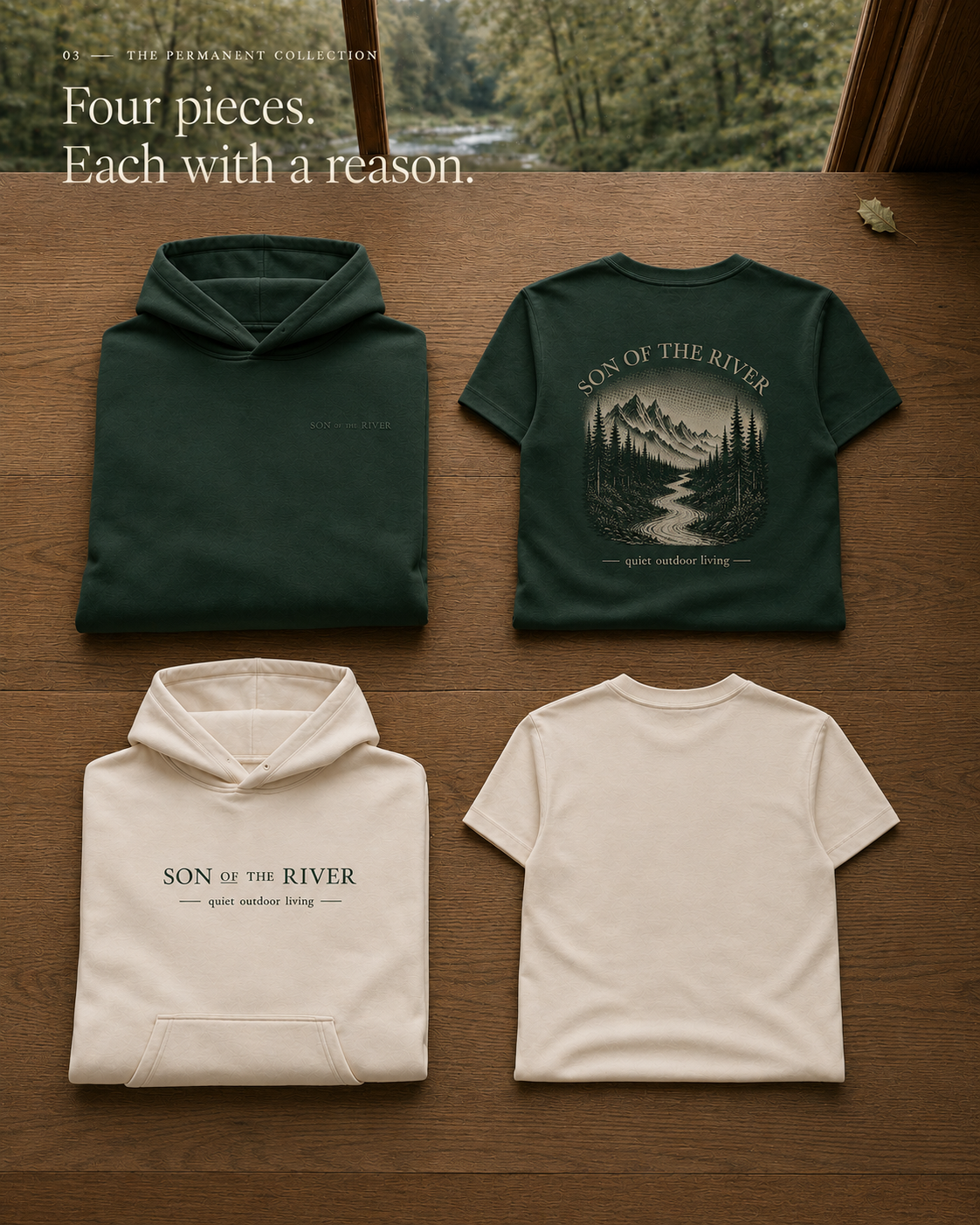
Heavy Hoodies.
Heavy T-Shirts.
A Cap.
Two core colours.
River Moss and River Cream.
Not because these are the only pieces we will ever make.
But because they are enough to establish what the collection should feel like.
Before adding more, we want to understand the pieces already here.
Every piece needs a reason
A product should not exist simply because there is space for another product.
That sounds obvious.
In practice, it is surprisingly easy to keep adding.
Another colour.
Another graphic.
Another variation.
Another seasonal version.
Soon, choice becomes the collection.
We want to work differently.
Before something new is added, there should be a reason for it.
Does it serve a different moment?
Does it offer something the existing collection does not?
Does it belong beside the pieces already there?
Would we still want to make it if there were no pressure to release something new?
If the answer is unclear, perhaps the collection does not need it yet.
Two colours are enough to begin
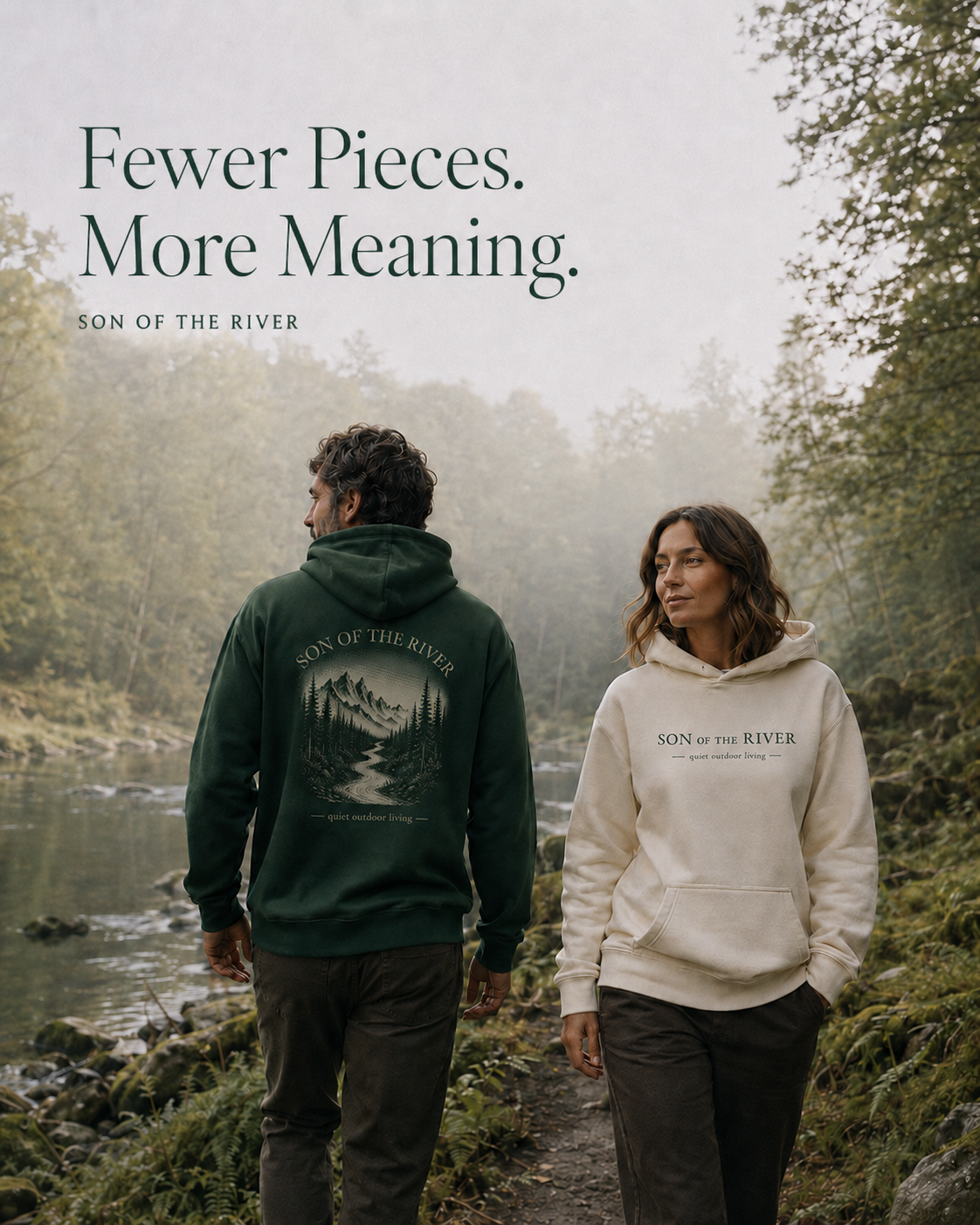
River Moss and River Cream were chosen to form the foundation.
Not seasonal colours.
Not trend colours.
Permanent colours.
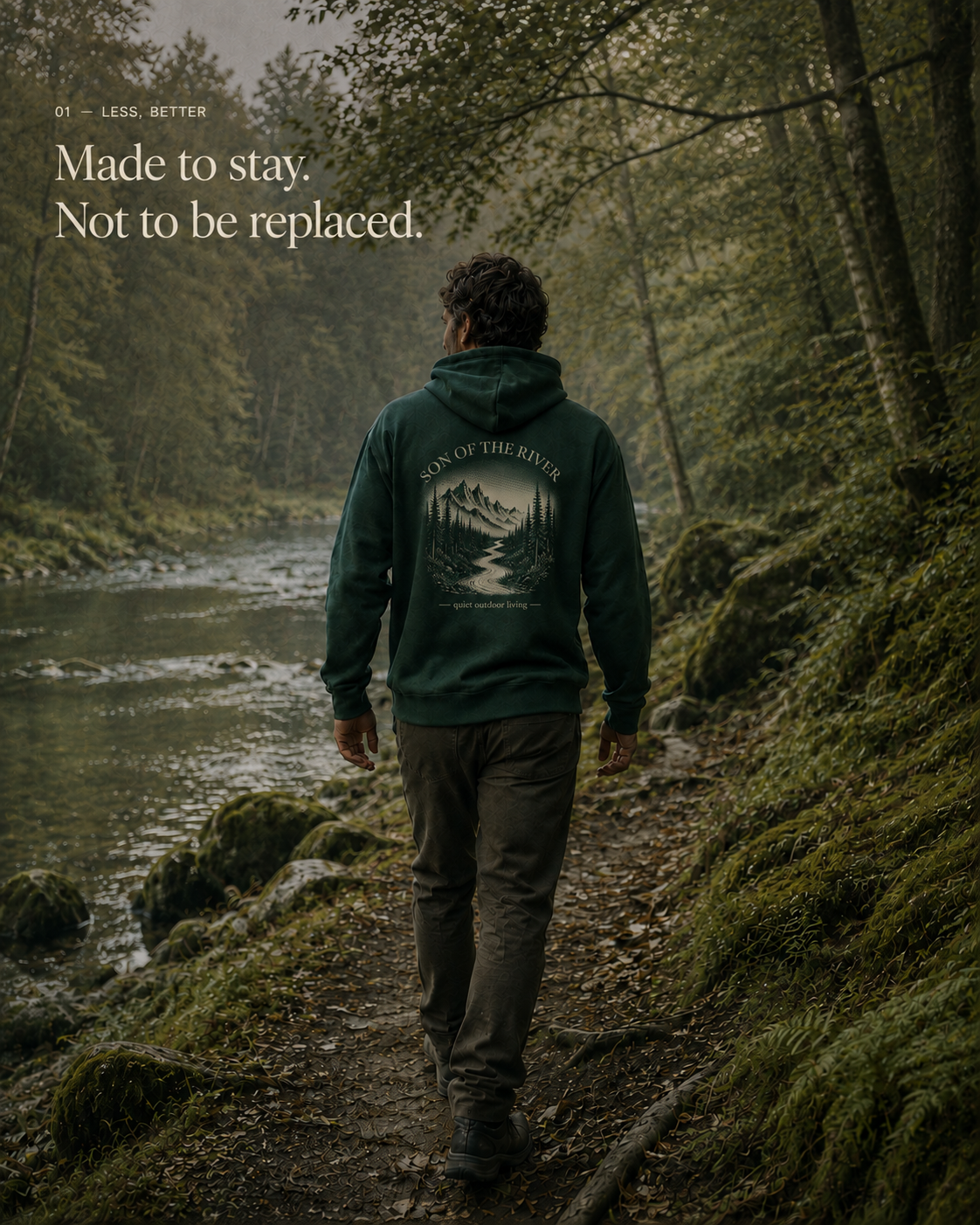
River Moss carries more of the visual identity.
It is deeper.
Earthier.
Closer to the forest and the landscape behind Son of the River.
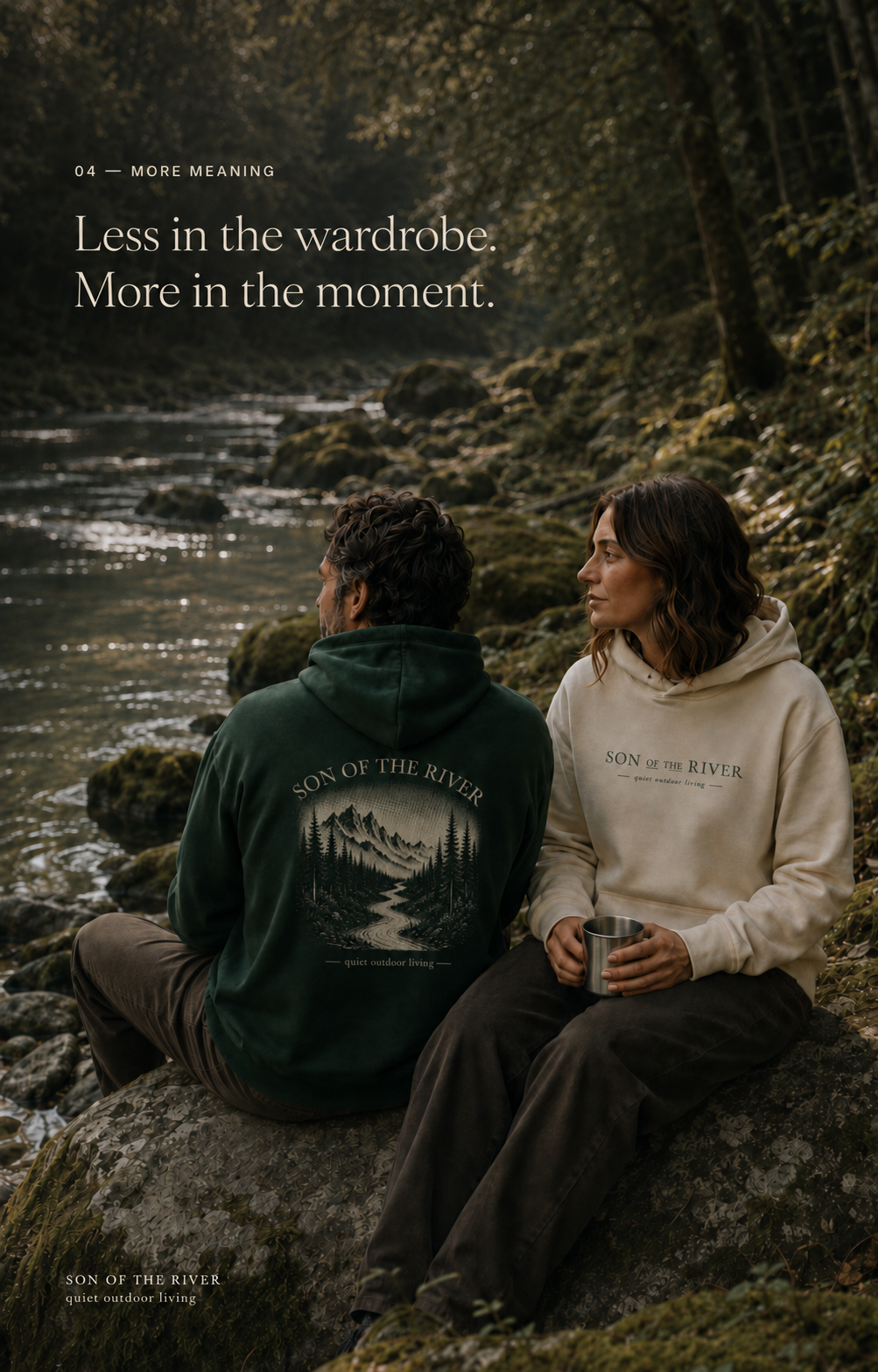
On selected pieces, it also carries the two-colour landscape backprint.
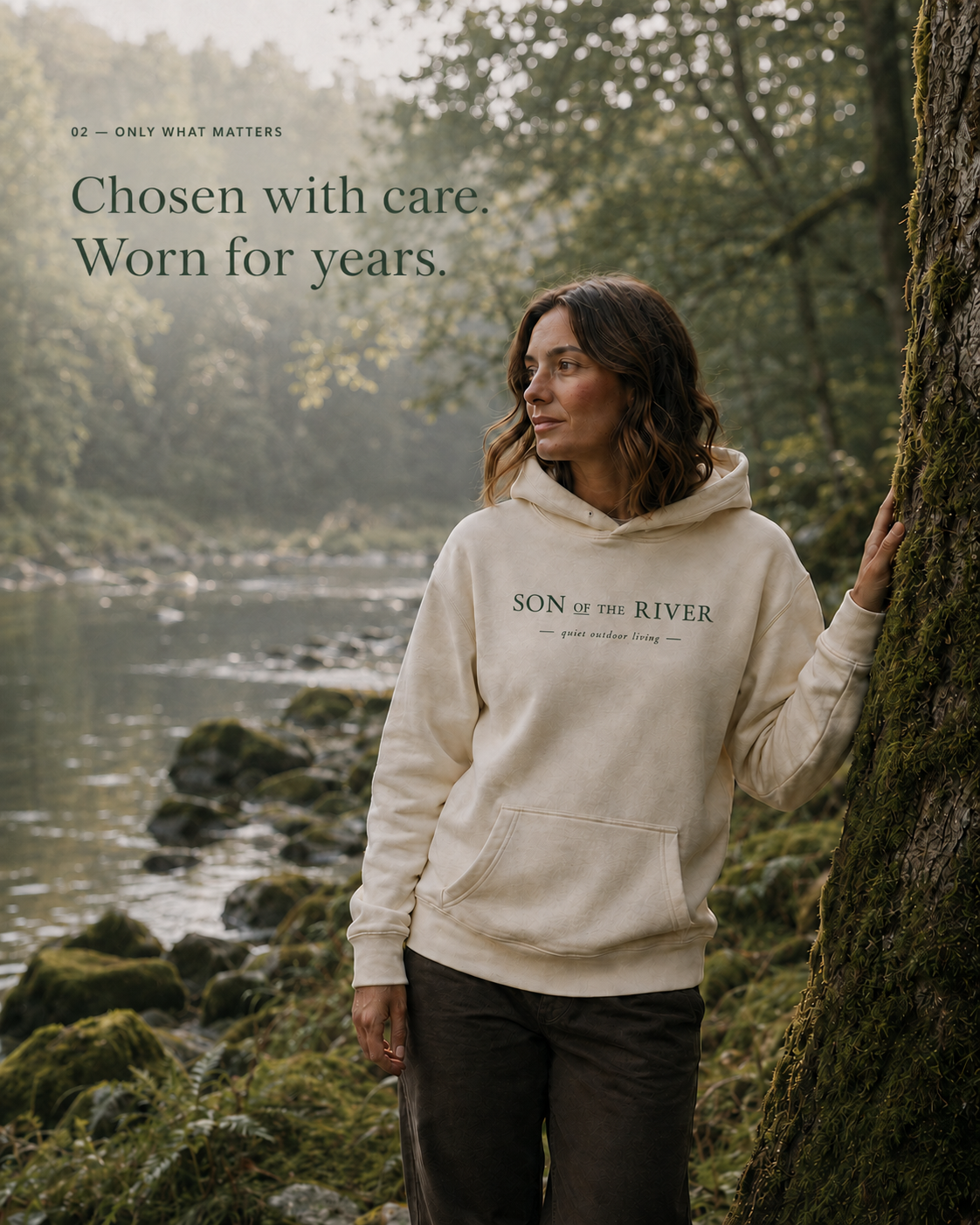
River Cream takes the opposite role.
Lighter.
Quieter.
Cleaner.
The large landscape backprint disappears.
What remains is a calmer expression of the same collection.
Two colours.
Two different moods.
One shared foundation.
Permanent does not mean never changing
A Permanent Collection does not mean that nothing will ever evolve.
Fits may be refined.
Materials may improve.
Details may change when there is a good reason.
New pieces may eventually join the collection.
But the foundation does not need to disappear every few months simply because another season has started.
River Moss should still feel like River Moss next year.
A Heavy Hoodie should not suddenly become irrelevant because a new drop has arrived.
The idea is continuity.
Not stagnation.
Clothes can become familiar
There is value in familiarity.
The sweatshirt you reach for without thinking.
The T-shirt that already feels right.
The cap that lives beside the door.
Clothing does not always need to feel new.
Sometimes the opposite is better.
A piece begins to become yours when the newness disappears.
It softens.
It gets worn.
It travels.
It spends mornings outside.
It gets folded badly.
It waits on the back of a chair.
It becomes associated with places, people and ordinary days.
That relationship takes time.
Constant replacement rarely allows much of it.
Heavyweight by intention
The first collection is built around substantial fabrics.
The Heavy Hoods use a 400 GSM foundation.
The Heavy Tees use 280 GSM heavyweight cotton.
These choices are not there simply so that we can place larger numbers on a product page.
Weight changes how a garment feels.
How it hangs.
How it holds its shape.
How substantial it feels when you pick it up.
The aim is not to make every product as heavy as possible.
The aim is to choose a material that fits the role of the piece.
A hoodie for cool forest mornings should feel different from a lightweight layer designed only for warm afternoons.
The material should make sense before the specification becomes a marketing line.
River Moss carries the landscape
The first collection also follows a simple visual rule.
River Moss carries the landscape.
River Cream stays clean.
That rule gives each side of the collection a reason to exist.
The River Moss pieces can express more of the visual world behind Son of the River.
Mountains.
Forest.
River.
Reduced to a two-colour backprint.
River Cream creates contrast by doing less.
It leaves more space.
The pieces work together because they do not all try to say the same thing.
Fewer options can make better choices
More choice often sounds like more freedom.
Sometimes it is.
But there is another side to it.
Ten shades of green do not necessarily make choosing a green easier.
Six almost identical T-shirts do not always make a collection more useful.
A smaller collection forces clearer decisions.
Which green?
Which fabric?
Which fit?
Which print?
Which placement?
What deserves to stay?
When there are fewer pieces, every difference becomes more important.
That constraint can be useful.
It makes us ask better questions.
Separate fits where it matters
Fewer pieces does not mean reducing every decision to one universal solution.
Sometimes simplicity requires more thought rather than less.
That is why the first clothing pieces are being developed with separate fits for women and men rather than simply treating one generic unisex shape as the answer to everything.
The collection remains small.
But within it, fit still matters.
Limitation should remove unnecessary choice.
It should not remove necessary consideration.
Clear information instead of bigger claims
Another part of making fewer pieces is being able to explain them properly.
Fabric weight.
Material composition.
Fit.
Garment measurements.
Decoration.
Care.
Country of production.
Relevant certifications.
These details are less exciting than large words such as premium, responsible or sustainable.
But they are more useful.
We would rather show what a piece is made from and how it was developed than ask a visitor to trust a vague adjective.
The details should be available.
The decision remains yours.
No artificial urgency
A permanent collection also changes the way products need to be communicated.
There does not need to be a new collection simply because a new season has arrived.
There does not need to be another colour because social media needs something different to show.
And there does not need to be constant pressure to buy before the next thing replaces what came before.
There will still be moments when pieces are unavailable.
Production takes time.
Quantities may be limited.
Some products may sell out.
But scarcity should come from the reality of making things in sensible quantities.
Not from manufacturing urgency as a marketing technique.
Growing slowly gives us time to learn
The first collection will not answer every question.
That is part of the point.
We want to see how the pieces behave outside a specification sheet.
How the print feels on the actual garment.
How River Moss looks in changing light.
How different fits work across different bodies.
Which pieces people return to.
Which details matter less than we thought.
Which matter more.
A smaller collection makes those lessons easier to see.
Then the next decision can be based on something real.
Not simply on the need to produce another drop.
More meaning does not come from less alone
Fewer pieces are not automatically better pieces.
Limitation by itself means very little.
The important part is what happens with the space it creates.
More attention to the fit.
More attention to the material.
More time with the print.
More care around colour.
More willingness to change something after seeing the physical sample.
More transparency about the decisions behind the product.
That is where the second half of the idea matters.
Fewer pieces.
More meaning.
A collection that has room to stay
The goal is not to build the smallest clothing collection possible.
Nor is it to promise that Son of the River will never grow.
It will.
There are other pieces we want to explore.
Other materials.
Other moments outside.
Other ideas that may eventually belong here.
But growth does not have to mean constant replacement.
Something new can join the collection without making everything before it feel old.
River Moss can remain.
River Cream can remain.
The Heavy Hoodie can remain.
The landscape can remain.
The collection can grow around a foundation rather than repeatedly replacing it.
Start with what matters
For now, that foundation is intentionally simple.
Heavyweight layers.
Two permanent colours.
A landscape backprint where it belongs.
Clean pieces where it does not.
Separate fits.
Clear product information.
And enough room to learn before adding more.
There will always be another possible colour.
Another possible product.
Another idea waiting.
We do not need to make all of them.
Only the ones that have a reason to stay.
Fewer pieces. More meaning.